How to Tell Stakeholders the Date Slipped (Without Losing the Room)
Every PM eventually has to say the date moved. The difference between a bad week and a credibility hit is when you say it, and what's on the slide behind you when you do.
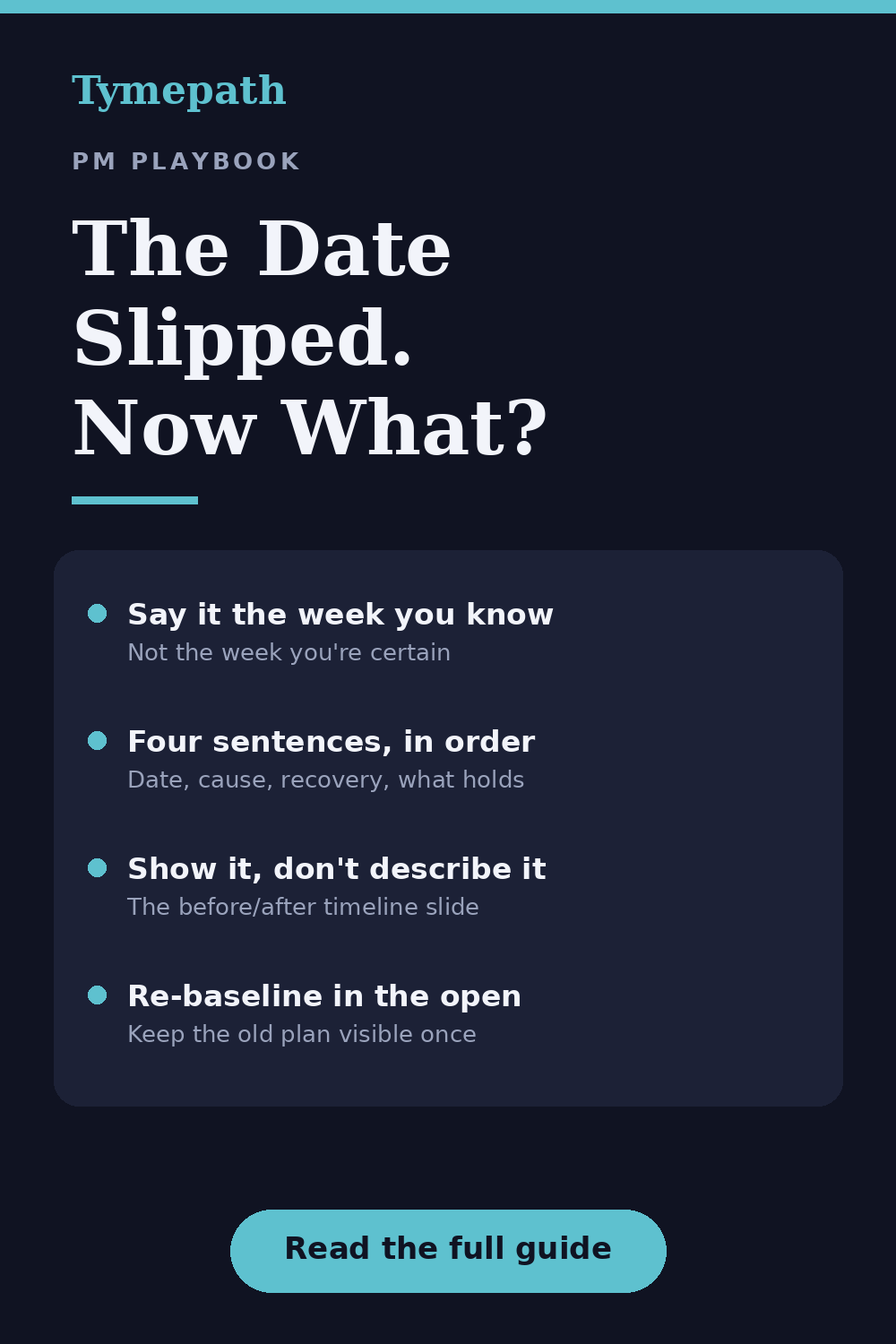
There's a specific silence that follows "we're going to miss the date." Every PM knows it. What most of us learn slowly — usually by doing it badly once — is that the silence isn't really about the slip. Stakeholders have all seen slips; portfolios price them in. The silence is the room deciding, in real time, whether you're still the person who knows what's going on. That's the actual stake in a delay conversation: not the date, your credibility. And it's winnable, because credibility in that moment comes from three controllable things — when you say it, what you say, and what's on the slide behind you.
When: the day you know, not the week you're sure
The most expensive delay-communication mistake is waiting for certainty. The trajectory is usually visible weeks before it's undeniable — the dependency that landed late, the integration test that keeps finding things, the vendor who went quiet. PMs sit on it because they're hoping the next sprint claws it back, and occasionally it does. But here's the asymmetry: flagging a risk that later resolves costs you almost nothing ("good news, we recovered the week"), while announcing a slip the room suspects you saw coming costs you exactly the thing you were protecting. The working rule: the moment your honest internal forecast moves, your stakeholders' forecast should move within the week. You're allowed to bring a recovery plan; you're not allowed to bring a surprise.
What: the four-sentence structure
Delay communications fail in two symmetrical ways: the confessional (ten minutes of context and apology before the date finally appears) and the ambush (the new date with nothing around it). The structure that works is four sentences, in order:
- The headline, dates first: "Launch moves from November 9 to December 2 — three weeks."
- The cause, one sentence, no adjectives: "The payment-provider migration returned three weeks of rework we didn't have in the plan."
- What you're doing about it: what got cut, what got parallelized, what you need from the room.
- What doesn't move: the commitments that still hold. This is the sentence people remember.
Notice what's not in the structure: blame, a tour of everything that went right, or the word "unfortunately." One cause, honestly named, reads as control. Three causes read as chaos, even when they're all true — pick the binding constraint.
The slide: show the slip, don't describe it
Here's where most delay conversations quietly go wrong. The PM says "three weeks," and every person in the room privately imagines a different three weeks — the CFO sees the revenue quarter, engineering sees the freeze window, marketing sees their campaign booking. Words leave the impact to the imagination, and imaginations are pessimists. A before/after timeline ends that: the old plan and the new plan on one slide, same scale, same lanes, so the room can see that the slip is contained to one workstream — or see honestly that it isn't. The milestones that hold sit there visibly not moving, which is the strongest version of sentence four you can deliver.
The mechanics of that slide used to be the problem: re-drawing a PowerPoint timeline at 11 p.m. the night before a difficult meeting is nobody's best work, and hand-nudged rectangles have a way of understating slips — a bar dragged "about three weeks" reads however the eye wants it to read. This is exactly the situation we built Tymepath for. Your plan lives as a task list — rows with start dates, end dates, workstream, milestone flags. When the date moves, you change the cells that changed and the timeline redraws with date-true spacing; the slip shown is exactly the slip. Duplicate the project first and you have your "before" untouched — export both, drop them on one slide, done. Seventeen styles means the same re-baselined plan can face the steering committee as a quarter-level roadmap on Tuesday and the delivery team as a full Gantt on Wednesday, without maintaining two files that will inevitably disagree.
All of that is free-tier, no credit card — a single project's re-baseline is exactly the kind of thing you should be able to do in the ten minutes before the meeting, not the two hours after your kids go to bed.
Re-baselining without burying the news
One trap to name, because senior stakeholders are wise to it: the quiet re-baseline, where the plan silently becomes the new plan and last month's dates are never spoken of again. It feels merciful; it reads as slippery. The credible move is the opposite — keep the old baseline visible for exactly one review cycle. "The gray bars are the September plan" is an uncomfortable slide to present once, and it buys you the thing that makes the next six months easier: a room that believes your dates because it watched you keep score against them.
The 10-second version
Tell them the week your forecast moves, not the week you're certain. Four sentences: new date, one cause, the recovery, what still holds. And bring the before/after timeline instead of describing it — a slip the room can see is a decision; a slip the room imagines is a crisis.
If the re-baselined plan needs to become a slide today, the template gallery has an executive roadmap and a full Gantt pre-loaded with sample tasks — swap in your dates, duplicate for the before/after, and export to PowerPoint, PNG or PDF.
Try Tymepath free
Re-baseline your timeline and export the before/after slide in minutes. Free tier, no credit card required.
Try Tymepath free